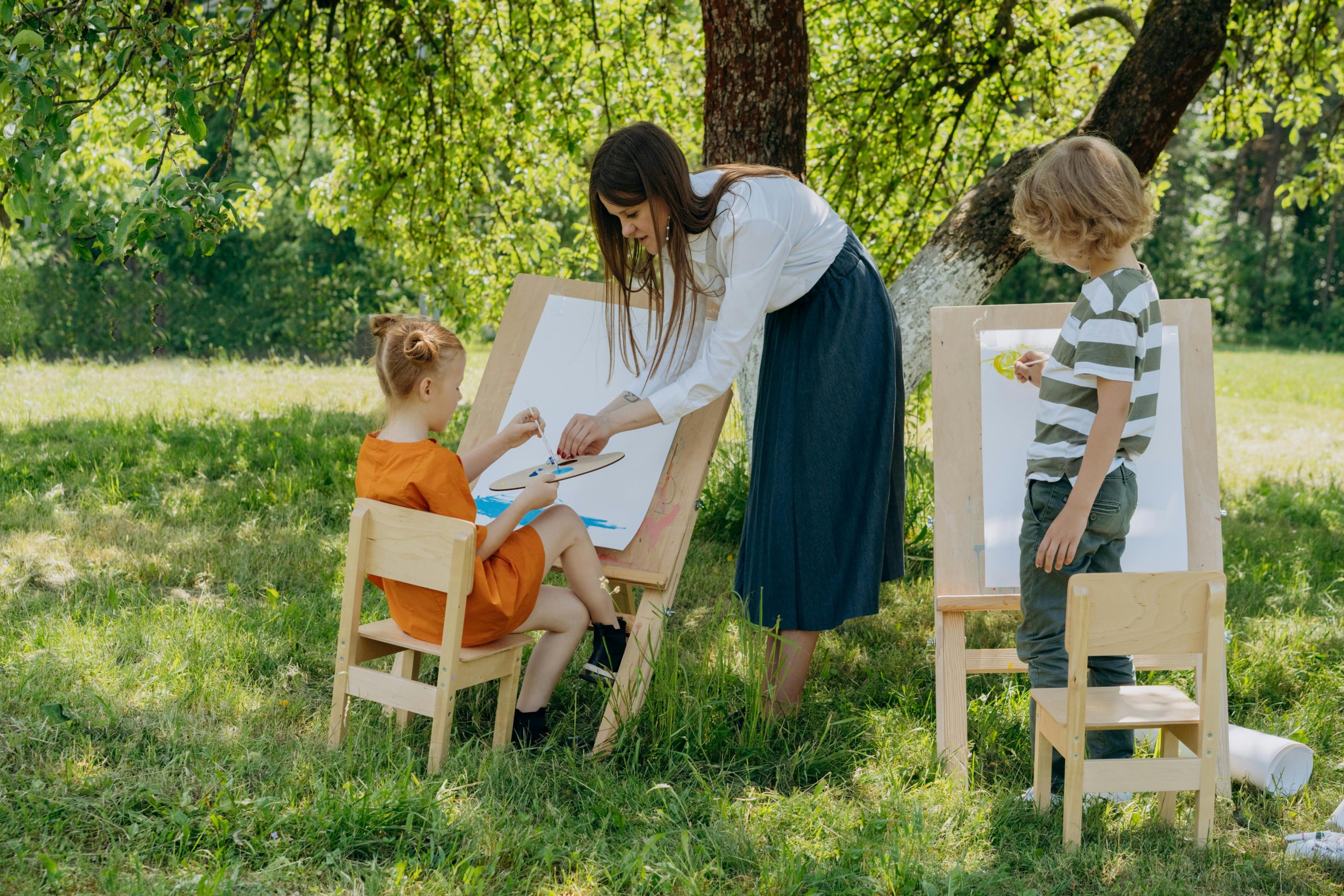
A Practical Guide for Homeschooling Families
Nature School Is a Mindset, Not a Location
When many families hear the term “nature school,” they imagine a forest classroom, a rural farm, or a lakeside cabin tucked away from the world. But the truth is far simpler, and far more empowering.
A nature school is not defined by acreage. It is defined by intention. Whether you live on a farm, in a forest home, beside a lake, in a suburban backyard, or even in a neighborhood with trees and walking paths nearby, you can transform any curriculum into a nature-based learning experience.
Nature school is not about abandoning structure. It is about relocating learning into the natural world and allowing the outdoors to become your classroom.
And yes! You can absolutely use your existing curriculum to do it!
What Counts as a Nature School?
Guess what? You may already have everything you need.
A nature school environment can be:
- A farm with animals and open fields
- A lakeside home with shoreline access
- A forest or wooded property
- A backyard with grass, trees, or garden beds
- A neighborhood with walking trails or tree-lined sidewalks
- A park within walking distance
If your child can step outside and observe wind, soil, insects, sunlight, plants, weather, or wildlife, then you can build a nature (home)school! The major key in doing this is shifting your perspective from “indoor instruction with outdoor breaks” to “outdoor instruction with indoor support.”
How Do I Start Building a Nature (Home)School?
Step 1: Start with Your Existing Curriculum
You do not need to purchase a separate “nature curriculum.” There is no need to break the bank! Instead, ask yourself:
- How can this lesson be taken outside?
- What natural element connects to this topic?
- How can my child physically experience this concept?
For example, let’s break this down even more!
Literacy
- Practice sight words using sidewalk chalk on a driveway.
- Read books under a tree.
- Write nature journals about daily outdoor observations.
- Use leaves or sticks to form letters.
Math
- Count rocks, acorns, or pinecones.
- Measure garden beds.
- Graph weather patterns.
- Practice fractions while dividing harvested vegetables.
Science
- Observe insect life cycles in real time.
- Track plant growth.
- Study ecosystems using your own backyard.
- Explore water properties at a lake or pond.
Art
- Create leaf rubbings.
- Paint with natural pigments.
- Build sculptures from sticks and stones.
Remember to think like this, make it your mantra: My curriculum provides structure. Nature provides the context.
Step 2: Plan by Theme (Weekly, Monthly, or Yearly)
Turning the curriculum into a nature school becomes easier when you organize learning by themes. Here’s how to structure it:
Weekly Nature Themes
Choose one nature-based focus per week:
- Soil & Decomposition
- Trees & Forest Layers
- Pond Ecosystems
- Weather Patterns
- Pollinators
- Seeds & Growth
Then connect your curriculum subjects to that theme.
Example: “Tree Week”
- Reading: Books about forests
- Writing: Tree observation journal
- Math: Measure tree circumference
- Science: Study photosynthesis
- Art: Leaf printing
Monthly Nature Units
Design a 4-week nature unit around:
- Fall Harvest
- Winter Wildlife
- Spring Renewal
- Summer Water Studies
This way your curriculum lessons stay intact, but the environment becomes immersive.
Year-Long Nature Integration
If you want a full nature school model:
- Follow seasonal cycles.
- Build routines outdoors.
- Create long-term observation projects (garden growth, bird migration, moon phases).
- Keep a nature portfolio.
You can even align your yearly curriculum scope and sequence with the natural calendar rather than a traditional academic one.
Step 3: Prepare Your Environment
You do not need expensive equipment.
Start simple:
- Blank notebooks for nature journaling
- A basket for collecting natural items
- A small magnifying glass
- Clipboards for outdoor writing
- Outdoor seating mats or picnic blankets
For backyard homes:
- Add a garden bed.
- Designate a “learning corner” outdoors.
In neighborhoods:
- Map safe walking routes.
- Identify nearby trees or water features.
For farms or lakeside homes:
- Schedule observation routines (animal care, shoreline study).
Preparation is about consistency, not complexity.
Step 4: Shift Your Teaching Style
In order to shift your teaching, you need to know what you are shifting it to! Right? Nature schools prioritize:
- Observation before explanation
- Curiosity over memorization
- Movement over sitting
- Real-world experience before worksheets
Instead of introducing a science concept indoors and reinforcing it outside, reverse it:
- Experience first.
- Explain second.
- Document third.
Another mantra for you: My curriculum becomes the academic backbone, and nature becomes the living laboratory.
Step 5: Balance Structure and Freedom
One of the most common misconceptions about nature schooling is that it lacks structure. That does not have to be true.
You can still:
- Follow your curriculum schedule.
- Set clear learning objectives.
- Track progress.
- Maintain portfolios.
- Complete assessments.
You are simply relocating the environment. This is especially helpful for families using structured online or printable curricula because it allows academic consistency while maintaining outdoor immersion.
Turning The Moneá Academy Curriculum into a Nature School
Now, T.M.A Family, I know you have been waiting on this portion! So, if you are using our curriculum, here is how to transform it:
- Watch our “Plan With Me” video for the month
- Review the weekly theme
- Identify 2–3 lessons that can be taught outdoors.
- Replace one indoor activity with a nature-based equivalent.
- Add journaling or sketching.
- Tie lessons to seasonal changes. (We made it flexible for moments like this!)
You do not need to rewrite anything. You adapt delivery, not the content. Over time, this creates a fully immersive nature-based homeschool experience.
Tips & Tricks for Success
✔ Start with 2–3 outdoor lessons per week, not every subject at once.
✔ Dress for the weather: consistency matters more than comfort preferences.
✔ Keep expectations flexible. Nature is unpredictable.
✔ Embrace mud, wind, and noise as part of learning.
✔ Use reflection time indoors to connect observations to academic vocabulary.
✔ Document learning through photos and portfolios.
Nature school thrives on rhythm, not perfection.
A Brief Note on Nature School Accreditation
If families choose to form nature-based co-ops or outdoor learning groups, some states may require specific oversight or accreditation. In certain cases, programs align with organizations such as the North American Association for Environmental Education (NAAEE) or Nature Explore for environmental education standards.
Requirements vary by state, so families should review local homeschool and co-op regulations before formally organizing programs. For individual homeschool families, requirements are typically determined by state homeschool laws.
Always remember you can check your homeschool laws briefly here, and in depth here!
Nature Is Already Your Classroom
You do not need
- a forest campus.
- acres of land.
- to abandon your curriculum.
You need intention.
When you shift your perspective, your farm becomes a biology lab.
Your lake becomes a science classroom.
The backyard becomes an art studio.
Your neighborhood becomes a geography lesson.
Nature school is not a product.
It is a philosophy.
And with thoughtful planning, you can turn any curriculum into a living, breathing outdoor education experience.
Reference
Elliott, M. (2026, January 15). Homeschool Laws by State: Your Guide to Important Legal Requirements. The Moneá Academy. https://themoneaacademy.org/homeschool-laws-by-state/
Home School Legal Defense Association. (2024). Homeschool Laws By State. HSLDA. https://hslda.org/legal
Photo by Mikhail Nilov